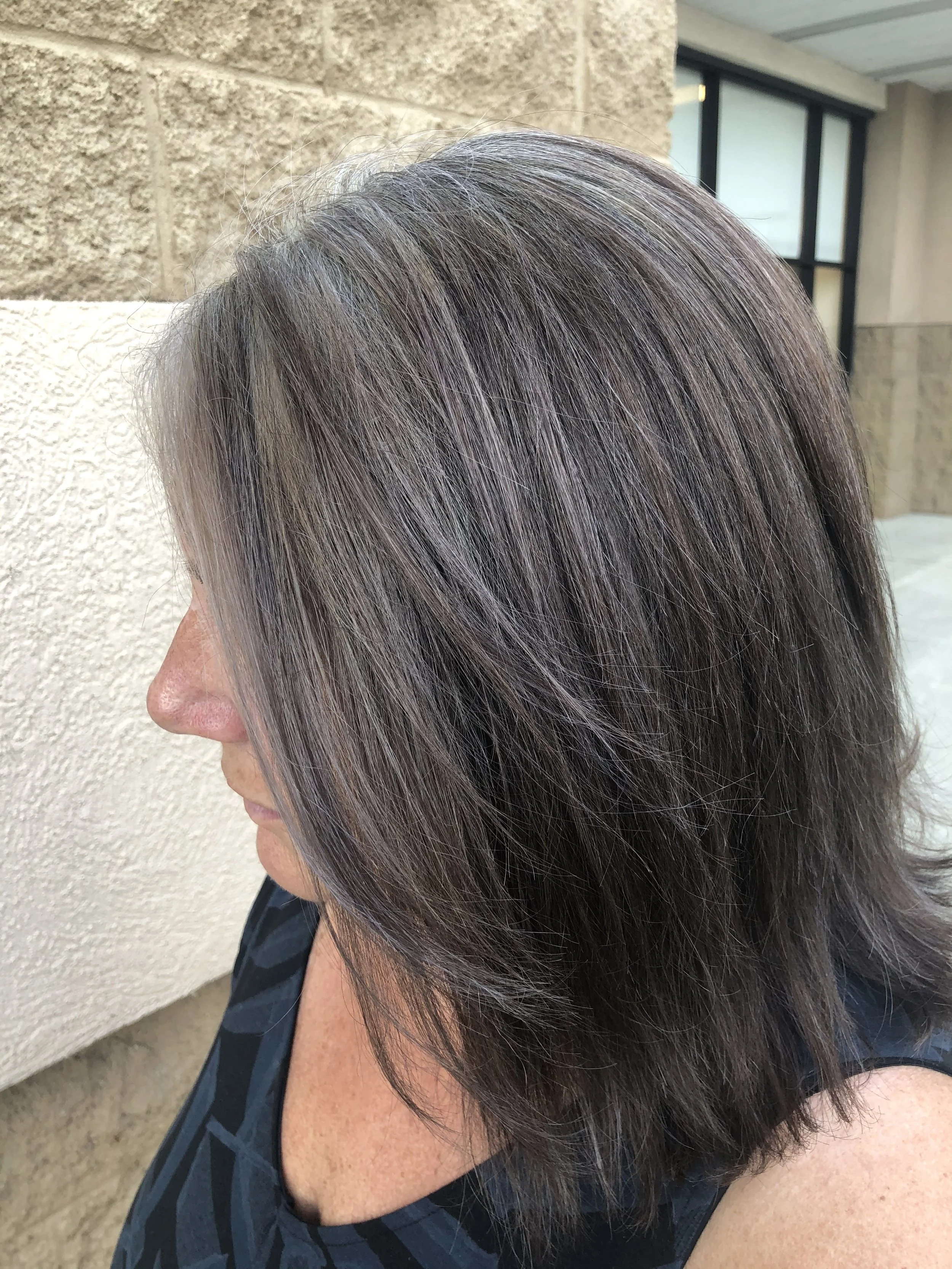
Your gray roots are showing, and you’re wondering whether it’s time for a different approach.
Maybe you love your brunette but feel like you’re constantly touching up the part line. Maybe you’re curious about your natural silver but don’t want a sharp line while it grows out. Or maybe you simply want reliable coverage and a color that feels like you.
Gray blending and gray coverage serve different goals. At Mercury Salon in New Smyrna Beach, we help you choose an approach based on how much gray you want to see, the look you love, and the upkeep that fits your life.
What’s the difference between gray blending and gray coverage?
Gray coverage aims to conceal gray strands. Gray blending aims to soften their contrast with the rest of your hair.
Coverage is often achieved with permanent color formulated for that purpose. Blending may involve highlights, lowlights, a more translucent color service, or a combination of techniques.
Gray blending doesn’t necessarily mean going fully gray. It can be a way to keep a brunette or blonde look while allowing some natural silver to remain visible.
When gray coverage might be right for you
If you prefer not to see gray in your finished color, coverage may be the better fit.
You might choose it if:
You want a consistent shade through your root area.
You love your current color and want to maintain it.
Seeing silver strands bothers you more than scheduling root appointments.
You’re comfortable with regular upkeep.
Full coverage doesn’t have to mean flat, one-color hair. Your stylist can pair root coverage with dimensional highlights or other color work through the lengths.
The tradeoff is regrowth: your natural gray will return as your hair grows. The contrast may be especially noticeable when the colored hair is much darker than the new growth.
When gray blending might be right for you
Blending may suit you if you’re comfortable seeing some gray but want it to feel more connected to your overall color.
You might choose it if:
You want a softer transition at the root.
You like dimension rather than a solid color.
You’re curious about embracing more of your natural silver.
You’d like to explore a less rigid root-touch-up routine.
The key question is whether you’re happy for some gray to remain visible. If your goal is to hide every silver strand, blending may leave you feeling under-covered.
Can you blend gray on naturally dark hair?
Yes. Naturally dark, salt-and-pepper hair can be a beautiful starting point for gray blending.
Highlights can introduce lighter pieces that soften the contrast between dark hair and silver strands. Lowlights may be useful when depth needs to be added or balanced.
Placement matters, too. Your gray may be concentrated near your face, along your part, or in distinct patches. Your stylist can work with that pattern rather than treating every section the same.
You don’t automatically have to become blonde. The goal may be a dimensional brunette that incorporates your silver, or a more pronounced salt-and-pepper finish.
Does gray blending always mean silver highlights?
No. The tone depends on your natural color, your gray pattern, and the look you prefer.
Some clients want a cool, silver-focused result. Others prefer neutral brunette dimension or softer blonde pieces that make the gray less noticeable.
Very cool or silver results can require significant lightening and ongoing tone maintenance. Your stylist can explain what’s achievable for your starting point, especially if your lengths already contain dark artificial color.
Can you switch from full coverage to gray blending?
Often, yes—but the transition deserves its own plan.
If your roots are naturally gray and your lengths have years of darker color, adding a few highlights may not fully soften the difference. Your stylist may need to address old color, uneven bands, or previous lightening.
That can make the first stage a larger color service than a routine root touch-up. A gradual transition may be appropriate, and some transformations require more than one appointment.
Bring your color history and discuss what you’d feel comfortable wearing between visits. You don’t have to commit to growing everything out without support.
Which option needs less maintenance?
Gray blending can make regrowth less noticeable, which may allow more flexibility between color visits. It still may need glosses, toner refreshes, or occasional highlighting to maintain the finish you like.
Gray coverage usually calls for more regular root appointments if you want to keep new gray concealed.
The right schedule depends on how your hair grows, where your gray appears, your preferred shade, and how much regrowth you’re comfortable seeing.
Also distinguish the initial transition from ongoing upkeep. Establishing a gray blend can take more time and investment than maintaining it later.
What should you discuss during your consultation?
Start with these questions:
How much gray am I comfortable seeing?
Do I want to stay brunette, feel lighter, or move toward my natural silver?
What bothers me most: the gray itself, the root line, or the appointment schedule?
What color is already on my lengths?
What would the first appointment involve, and how would I maintain it?
You can also say, “I want softer regrowth, but I’m not ready to go fully gray.” That’s a clear starting point for a personalized conversation.
Find your gray color plan at Mercury Salon
You can choose coverage, blending, or a customized combination. Your preference matters just as much as your gray pattern.
At Mercury Salon on the North Causeway in New Smyrna Beach, we offer personalized gray blending, gray coverage, and dimensional color to help you find a result that feels like you.